Gumbel Distribution

Author

John Robin Inston

Published

August 30, 2026

1 Introduction

The Gumbel distribution is a continuous probability distribution used to model the maximum (or minimum) of a sample. It is one of the three extreme-value distributions and describes the limiting distribution of the maximum of many independent light-tailed variables.

A random variable \(X\) follows a Gumbel distribution with location parameter \(\mu \in \mathbb{R}\) and scale parameter \(\beta > 0\) if

\[ X \sim \text{Gumbel}(\mu, \beta). \]

2 Probability Density Function

Writing \(z = \dfrac{x - \mu}{\beta}\), the probability density function is

\[ f(x) = \frac{1}{\beta} \exp\!\left(-\left(z + e^{-z}\right)\right), \quad x \in \mathbb{R}. \]

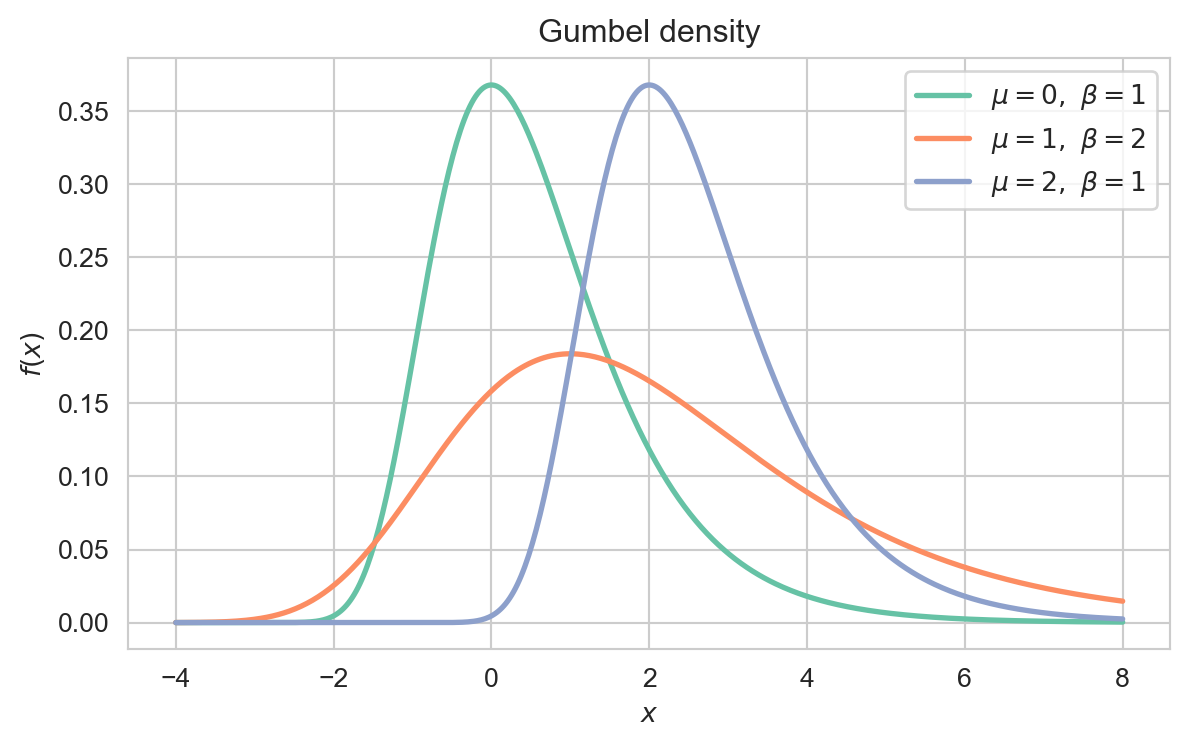
Interpretation: The density is right-skewed, with a heavier upper tail reflecting the occasional very large maximum.

Plotting code
import numpy as np
import matplotlib.pyplot as plt
import seaborn as sns
from scipy.stats import gumbel_r

sns.set_style('whitegrid')
sns.set_palette('Set2')

x = np.linspace(-4, 8, 500)
fig, ax = plt.subplots(figsize=(7, 4))
for mu, beta in ((0, 1), (1, 2), (2, 1)):
    ax.plot(x, gumbel_r.pdf(x, loc=mu, scale=beta),
            lw=2, label=rf'$\mu={mu},\ \beta={beta}$')

ax.set_xlabel('$x$')
ax.set_ylabel('$f(x)$')
ax.set_title('Gumbel density')
ax.legend()
plt.show()

Density of the Gumbel distribution for several location and scale parameters \((\mu, \beta)\).

The cumulative distribution function is

\[ F(x) = \exp\!\left(-e^{-(x - \mu)/\beta}\right). \]

3 Key Properties

For \(X \sim \text{Gumbel}(\mu, \beta)\),

\[ \mathbb{E}[X] = \mu + \beta\gamma \quad \& \quad \operatorname{Var}(X) = \frac{\pi^2}{6}\beta^2, \]

where \(\gamma \approx 0.5772\) is the Euler–Mascheroni constant.

Proof. With \(z = (x - \mu)/\beta\) and the substitution \(u = e^{-z}\), the mean reduces to \(\mu + \beta\int_0^\infty (-\ln u) e^{-u} \, du = \mu + \beta\gamma\), using \(\int_0^\infty (-\ln u) e^{-u}\,du = \gamma\). The variance follows from the second logarithmic moment of the exponential.

4 Generating Function

The moment generating function (MGF) of \(X \sim \text{Gumbel}(\mu, \beta)\) is
\[ M_X(t) = e^{\mu t}\,\Gamma(1 - \beta t), \quad t < \frac{1}{\beta}, \]

where \(\Gamma\) is the gamma function.

5 Relationship to Other Distributions

  • Exponential Distribution: If \(Y \sim \text{Exponential}(1)\), then \(\mu - \beta\ln Y \sim \text{Gumbel}(\mu, \beta)\).
  • Weibull Distribution: If \(X \sim \text{Weibull}(k, \lambda)\), then \(-\ln X\) is Gumbel distributed; both are extreme-value laws.
  • Extreme value theory: The Gumbel is the limiting distribution of the maximum of i.i.d. light-tailed variables (type I extreme value).

6 Examples and Applications

Annual maximum river levels and rainfall extremes are modelled with the Gumbel distribution to estimate flood return periods.

Peak loads, maximum wind speeds, and material strength extremes are analysed using Gumbel models for design safety margins.

The Gumbel distribution of utility shocks gives rise to the logit model used throughout discrete-choice and machine-learning classification.

7 Backlinks

Back to top