Interest
Interest rates, compounding and the time value of money.
1 Time Value of Money
In finance you never do anything for free and you would always prefer to have money now rather than later. For example, if you loan someone money, you expect to be compensated for giving up the opportunity to use that money for some other purpose. This is the time value of money and the compensation is called interest.
Interest is the cost of borrowing money or the return on investment for lending money. It is typically expressed as a percentage of the principal amount over a specified period of time.
Suppose we loan an initial amount (the principal) \(P\) to a borrower for some period of time. To compensate us for the use of our money, the borrower agrees to pay interest at an agreed rate. Interest accrues as it is earned and is added to the principal. The total amount owed at the end of the loan is called the future value \(F\).
How much interest is earned depends on the periodic rate \(r\), the number of periods \(m\) (determined by the loan duration and the payment frequency), and whether the interest is simple or compound.
Throughout, \(r\) is the rate per period (the effective annual rate when the period is one year), \(m\) is the number of periods (the number of compounding periods per year when we work over one year), \(r^{(m)}\) is a nominal annual rate compounded \(m\) times per year, \(\delta\) is the continuously compounded rate and \(t\) is measured in years.
2 Simple vs Compound Interest
In simple interest, the interest is calculated only on the principal
\[ F_s = P(1 + rm). \]
In compound interest, the interest is calculated on the accrued total (principal plus interest)
\[ F_c = P(1 + r)^m. \]
Suppose we loan \(P=\$100\) at a monthly interest rate of \(r=1.5\%\) for \(m=12\) months. The future value of the loan under simple and compound interest is
\[ \begin{aligned} F_s & = 100(1 + 0.015 \cdot 12) = 100(1.18) = \$118 \\ F_c & = 100(1 + 0.015)^{12} \approx 100(1.195618) \approx \$119.56. \end{aligned} \]
3 Present Value and Discounting
Compounding runs in reverse to give the present value of an amount \(F\) received after \(m\) periods. Solving \(F = P(1+r)^m\) for \(P\),
\[ P = F(1+r)^{-m} = F\,v^m, \qquad v = \frac{1}{1+r}, \]
where \(v\) is the discount factor for one period. Discounting is the same operation as compounding with the time direction reversed.
The effective discount rate is the interest paid in advance, per unit of the amount received at the end of the year,
\[ d = 1 - v = \frac{r}{1+r}. \]
The present value of \(\$1000\) received in 5 years at an effective annual rate of \(8\%\) is \(1000(1.08)^{-5} \approx \$680.58\).
In Interest Rates the discount factor over \([t,T]\) becomes the zero-coupon bond price \(p(t,T)\), which allows the rate to vary with time.
4 Annualization
In finance, interest rates are often expressed on an annual basis, even if the interest is compounded more frequently.
The nominal rate \(r^{(m)}\) is a stated annual rate that is compounded \(m\) times per year. It is quoted as a yearly figure, but interest is actually credited every \(1/m\) of a year at the periodic rate \(r^{(m)}/m\).
The effective annual rate \(r\) is the single once-a-year rate that produces the same growth as the nominal rate over one year. Since \(1\) dollar grows to \(\left(1+\frac{r^{(m)}}{m}\right)^m\) after one year with \(m\) compounding periods,
\[ 1 + r = \left(1 + \frac{r^{(m)}}{m}\right)^m \quad\Longleftrightarrow\quad r = \left(1 + \frac{r^{(m)}}{m}\right)^m - 1. \]
In North American consumer finance, the effective annual rate is called APY (annual percentage yield) for savings. The nominal rate on loans is called APR (annual percentage rate), which is usually just the periodic rate times the number of periods, so it understates the true cost relative to the effective rate. The process of converting a nominal rate to an effective annual rate is called annualization. Its main purpose is to provide a standardized way to compare interest rates across different financial products and investment opportunities, so that investors and borrowers can see the true cost or return of a product over a one-year period.
Suppose we take out a loan with a nominal interest rate of \(r^{(12)} = 6\%\) compounded monthly. The effective annual rate is
\[ r = \left(1 + \frac{0.06}{12}\right)^{12} - 1 \approx 1.061678 - 1 \approx 6.17\%. \]
To compare two nominal rates with different compounding frequencies, convert through the effective rate. Equating \(1 + r\) for frequencies \(m\) and \(k\) gives
\[ r^{(k)} = k\left[\left(1 + \frac{r^{(m)}}{m}\right)^{m/k} - 1\right]. \]
For example, \(r^{(12)} = 6\%\) is equivalent to \(r^{(2)} = 2\left[(1.005)^6 - 1\right] \approx 6.08\%\) compounded semi-annually.
5 Continuous Compounding
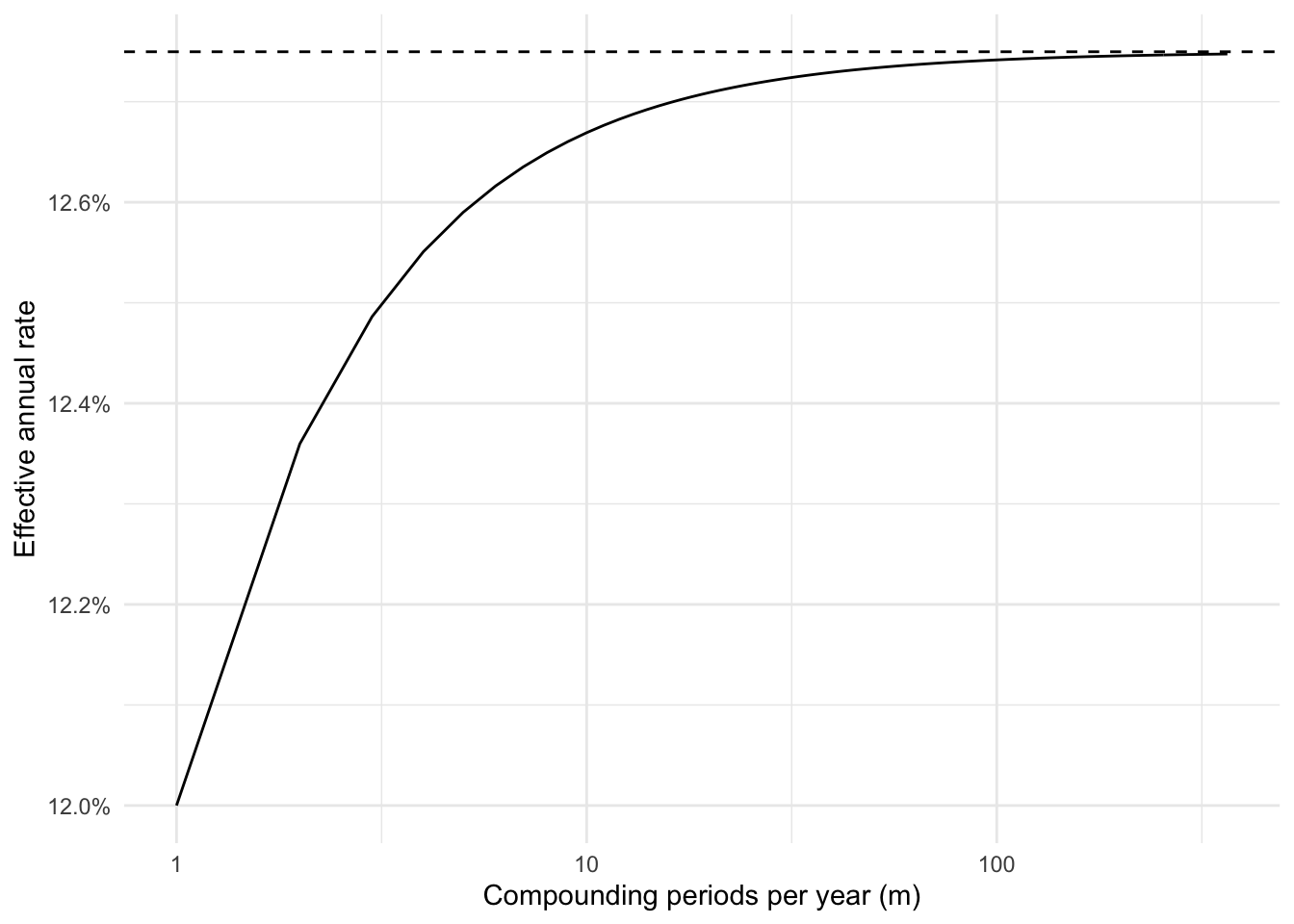
Continuous compounding is the limit of the nominal-rate setup as the number of compounding periods per year \(m \to \infty\). Interest is effectively credited over infinitesimally small periods, and the effective annual rate approaches an upper limit of \(e^r - 1\).
Start with the future value after \(t\) years at nominal rate \(r\) compounded \(m\) times per year, \(F = P\left(1 + \frac{r}{m}\right)^{mt}\), and take logs
\[ \ln\frac{F}{P} = mt\,\ln\!\left(1+\frac{r}{m}\right) \;\xrightarrow{\,m\to\infty\,}\; rt, \]
since \(\ln(1+x) \sim x\) as \(x \to 0\). Exponentiating gives
\[ F = P\,e^{rt}. \]
One can reach the same result by applying L’Hopital’s rule to the logarithm of the growth factor. There is no \(m\) in the formula: a common error is to carry \(m\) into the continuous formula, but \(e^{rt}\) already accounts for infinitely frequent compounding.
In actuarial notation, the continuously compounded rate is called the force of interest \(\delta\). The accumulation function is \(a(t) = e^{\int_0^t \delta(s)\,ds}\), which reduces to \(e^{\delta t}\) when \(\delta\) is constant. Equivalently, \(\delta\) is the logarithmic derivative of the accumulation function
\[ \delta(t) = \frac{a'(t)}{a(t)}. \]
When the force of interest varies in time it is called the short rate in Interest Rates. With a constant force of interest,
\[ 1 + r = e^{\delta}, \qquad \delta = \ln(1+r), \qquad \delta = \lim_{m\to\infty} r^{(m)}. \]
The force of interest is below the effective annual rate but above the effective discount rate \(d\). In terms of the nominal rates from before, \(r^{(m)}\) decreases toward \(\delta\) as \(m\) grows
\[ r = r^{(1)} > r^{(2)} > r^{(4)} > r^{(12)} > \cdots > \delta > d. \]
Converting a continuous rate to an effective annual rate (APY) is just \(e^{r}-1\). At \(r = 6\%\) this gives about \(6.184\%\). Take a \(12\%\) nominal rate:
| Compounding | Effective annual rate |
|---|---|
| Annual (\(m=1\)) | \(12.000\%\) |
| Monthly (\(m=12\)) | \(12.683\%\) |
| Daily (\(m=365\)) | \(12.747\%\) |
| Continuous (\(m\to\infty\)) | \(e^{0.12}-1 \approx 12.750\%\) |
Most of the gain from more frequent compounding comes by \(m=12\). On a deposit of \(\$1000\) for one year, daily and continuous compounding differ by about three cents ($1127.47 against $1127.50), so continuous compounding is used mainly for mathematical convenience.
Investing \(\$1000\) at \(8\%\) for 5 years gives \(1000\,e^{0.4} \approx \$1491.82\) under continuous compounding, versus \(\$1469.33\) with annual compounding.
To find a doubling time, solve \(e^{\delta t} = 2\)
\[ t = \frac{\ln 2}{\delta}. \]
Since \(\ln 2 \approx 0.693\), a rate of \(R\%\) doubles money in roughly \(70/R\) years. For annually compounded rates the rule of 72, \(t \approx 72/R\), is more accurate: at \(6\%\) it gives \(12\) years against an exact value of \(\ln 2 / \ln 1.06 \approx 11.90\).
6 Day-Count Conventions
The year fraction \(t\) used in practice depends on a market convention, so the same quoted rate can accrue slightly different amounts of interest. Common choices are
- Actual/365: actual days elapsed divided by \(365\).
- Actual/360: actual days elapsed divided by \(360\), common for money markets and LIBOR.
- 30/360: each month is treated as \(30\) days and each year as \(360\) days, common for bonds.