Cauchy Sequence
1 Introduction
Cauchy (mutual) convergence is a useful result when you have to prove convergence but do not have a good candidate for a limit. Cauchy convergence requires only information on pairs \((x_{n},x_{m})\).
Informally, a real sequence \(\{ x_{n} \}\) is Cauchy when the terms of the sequence become arbitrarily close together as \(n\) gets very large. We write a more concrete metric based definition of Cauchy sequences using the standard Euclidean metric.
A real sequence \(\{ x_{n} \}\) is Cauchy if
\[ \forall \epsilon >0, \exists N=N_{\epsilon}~s.t.~|x_{n}-x_{m}|<\epsilon ,\forall n,m>N, \]
or in other words \(x_{n}-x_{m}\to 0\) as \(n,m \to \infty\) independently.
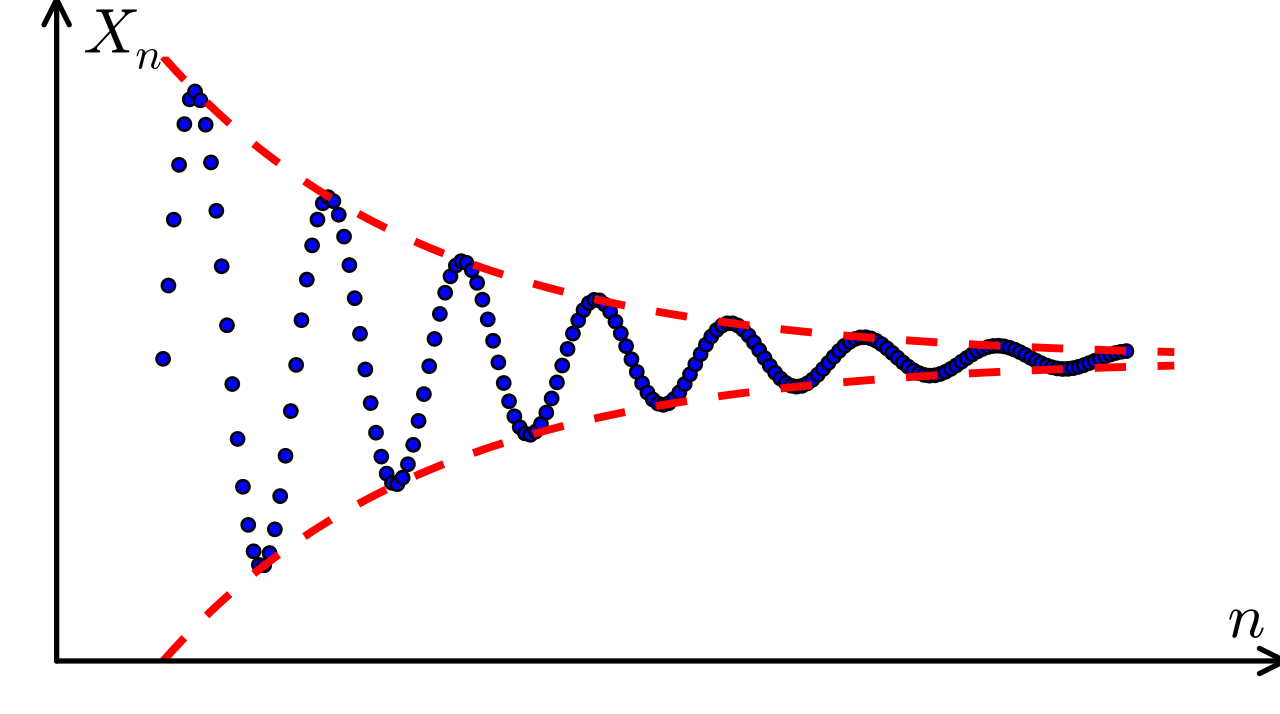
This leads to the following important result in Metric Spaces and Functional Analysis in general known as the Cauchy characterization of convergence for sequences.
A real sequence \(\{ x_{n} \}\) is convergent in the reals if and only if it is Cauchy.
Proof. (\(\Rightarrow\)) Convergent implies Cauchy. Suppose \(x_{n}\to x\). Given \(\epsilon>0\), choose \(N\) such that \(|x_{n}-x|<\epsilon/2\) for all \(n>N\). Then for any \(n,m>N\) the triangle inequality gives
\[ |x_{n}-x_{m}| \le |x_{n}-x| + |x-x_{m}| < \frac{\epsilon}{2} + \frac{\epsilon}{2} = \epsilon, \]
so \(\{ x_{n} \}\) is Cauchy.
(\(\Leftarrow\)) Cauchy implies convergent. This direction relies on the completeness of \(\mathbb{R}\) and proceeds in three steps.
A Cauchy sequence is bounded. Taking \(\epsilon=1\), there is an \(N\) with \(|x_{n}-x_{N+1}|<1\) for all \(n>N\). Hence every term lies in the interval \((x_{N+1}-1,\,x_{N+1}+1)\) except for the finitely many terms \(x_{1},\dots,x_{N}\), so the sequence is bounded.
Extract a convergent subsequence. By the Bolzano–Weierstrass theorem, the bounded sequence has a convergent subsequence \(x_{n_{k}}\to x\) for some \(x\in\mathbb{R}\). This is the step that uses completeness of the reals.
The whole sequence converges to the same limit. Given \(\epsilon>0\), use the Cauchy property to pick \(N\) with \(|x_{n}-x_{m}|<\epsilon/2\) for all \(n,m>N\), and pick \(k\) large enough that \(n_{k}>N\) and \(|x_{n_{k}}-x|<\epsilon/2\). Then for all \(n>N\),
\[ |x_{n}-x| \le |x_{n}-x_{n_{k}}| + |x_{n_{k}}-x| < \frac{\epsilon}{2} + \frac{\epsilon}{2} = \epsilon. \]
Therefore \(x_{n}\to x\).